By Mike Savage of New Canaan
November is the month my family sits down at a long table in New Canaan and takes stock of what we have. I love the ritual. But every year, somewhere between the second helping and the pie, my mind drifts south to a different kind of November — the one that arrives in the hill country of southern Honduras, where the question is not what will be on the table but whether the beans planted in September will survive long enough to get there.
My wife Sandra and I started the Savage-Rivera Foundation because of families in those hills. Over the years I have written here about why extreme weather deepens family poverty in Honduras, about the strain on the country’s clinics and hospitals, and about education and water and the quiet machinery of extended families. What I have not written about directly, until now, is the thing that sits underneath all of it: food. Not food as a commodity, but food as the first thing a child’s body needs and the first thing a struggling household gives up.
This is a post about hunger in a specific place — the Central American Dry Corridor — and about the single most effective, least glamorous program I know of for fighting it: a hot meal at school. It is also, because I cannot help myself, a post about why nutrition is fundamentally an investment question.
What the Dry Corridor Actually Is
If you draw a line along the Pacific side of Central America from southern Guatemala through El Salvador, across the southern and western departments of Honduras, and into Nicaragua, you have traced the Dry Corridor. It is not a desert. It is a belt of hills and valleys that gets a real rainy season — but one that has become erratic, interrupted by a mid-summer dry spell farmers call the canícula, and increasingly punctuated by storms at the wrong time of year.
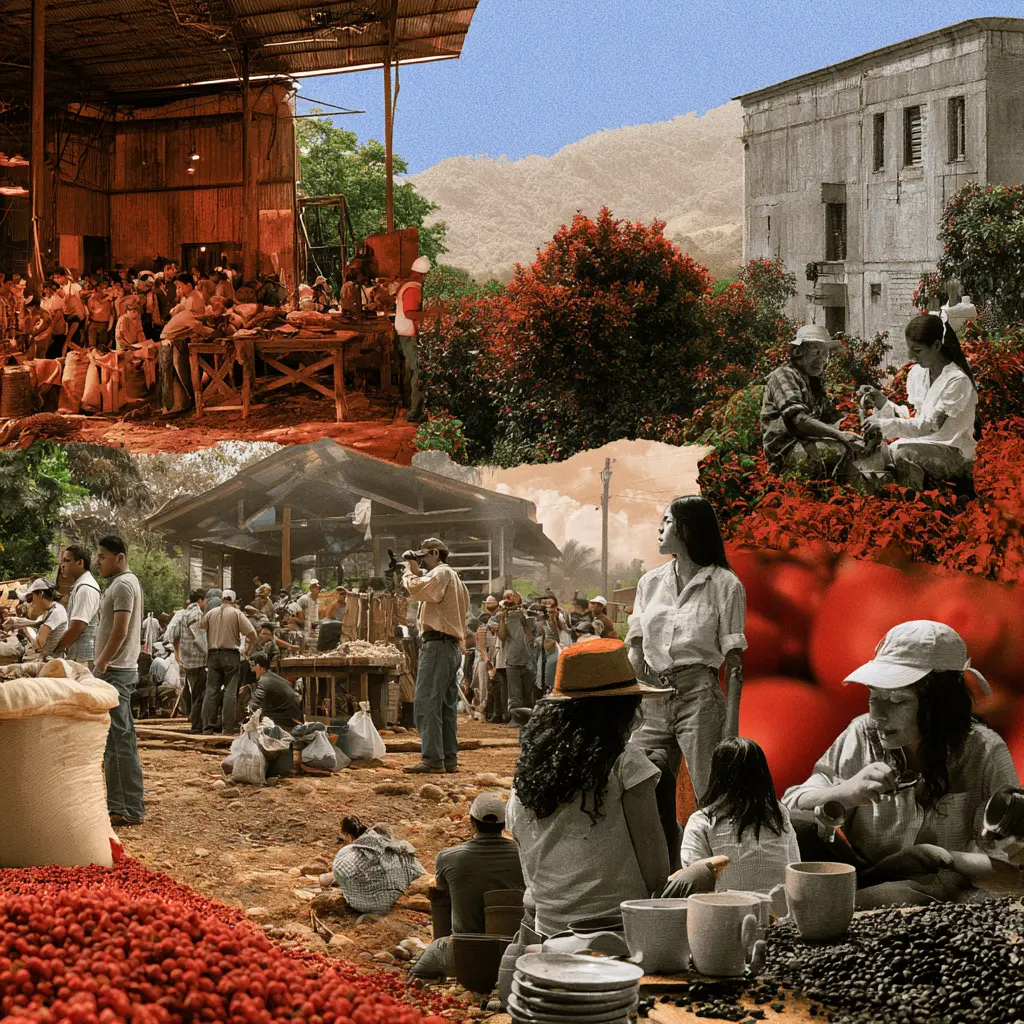
The people who live there are, overwhelmingly, subsistence farmers. They plant maize and beans in May for the primera harvest in August, and again in September for the postrera harvest in November and December. Nearly everything depends on those two plantings. The UN Food and Agriculture Organization has described the region as one of the most climate-vulnerable in the world, and notes that after the back-to-back hurricanes of 2020, production losses in parts of Honduras reached 61 to 80 percent. Its anticipatory-action work in the Dry Corridor exists precisely because the pattern is now predictable enough to plan around: a weak primera, a late postrera, and a stretch in between when the sacks in the corner of the kitchen are empty.
That stretch has a name in the field. Aid workers call it the lean season. The families I have met call it something simpler — the hungry months.
The Hungry Months
Here is how it plays out. A family of six on two or three manzanas of hillside land harvests their maize in August. In a good year it lasts until the postrera comes in. In a bad year — and the Dry Corridor has had more bad years than good over the last decade — it runs out in October. The beans they planted in September are still in the ground. There is no savings account. The father may walk to a larger farm to pick coffee for day wages, or he may already be gone, sending money home from the United States if the work is there.
What the household does next is what every household in the world does when money gets tight. It cuts. First the extras, then the variety, then the quantity. Meals go from three to two. The two become mostly tortillas. The mother eats last and least. And the youngest children — the ones whose brains and bones are being built right now — get the thinnest version of what was already a thin diet.
The World Food Programme’s most recent country brief puts the national picture in numbers. Honduras has roughly 10.7 million people, and projections from the national food security observatory estimated that around 1.4 million of them were food insecure as of March 2026, concentrated in rural and climate-affected areas. You can read the full WFP Honduras Country Brief for April 2026 yourself; it is short, and it is sobering.
What Hunger Does to a Child
There is a word that anyone who works in this space learns quickly, and that most people outside it have never heard: stunting. A stunted child is one whose height for their age is far below the norm — not because of genetics, but because chronic undernutrition in the first two years of life told the body to stop building. Stunting is not just about being short. It is a marker for everything that was not built alongside the bones: brain architecture, immune strength, the capacity to learn and to earn.
What makes stunting so cruel is that it is largely irreversible after about age two. The window is what nutritionists call the first 1,000 days, from conception to a second birthday. Miss that window and no amount of food later fully repairs it. A stunted five-year-old becomes a stunted adult, with on average less schooling, lower lifetime earnings, and a higher chance of raising a stunted child of her own.
In Honduras, according to WFP, roughly 19 percent of children under five are stunted — about 220,000 children — and the burden falls hardest on rural, Indigenous, and Afro-descendant communities, which is to say the Dry Corridor and the mountains of the west. WFP reports that its own nutrition program is currently reaching only about 3 percent of those children because of funding gaps. Read that again. Ninety-seven percent of the stunted children in the country are not being reached by the largest nutrition responder in the country.
The Global Nutrition Report’s Honduras profile adds another detail that stuck with me: only about 31 percent of Honduran infants under six months are exclusively breastfed, and the country is rated off course on every global nutrition target for which there is data. The government has committed to bringing stunting down from 19 to 14 percent by 2030. That is an achievable number. It is also a number that will not move on its own.
None of this is a story about parents who do not care. It is a story about a mother who is herself anemic, who had her first child at eighteen, who lives two hours from the nearest clinic, and who is feeding four children on what one person could reasonably live on. I wrote about the psychological weight that kind of scarcity puts on a family; the nutritional weight is the same story written on a child’s growth chart.
The Quietest Effective Program I Know
I have spent a career looking for things that work — in business, you learn to distrust the flashy and respect the boring thing that keeps producing. In Honduras, the boring thing that keeps producing is school feeding.
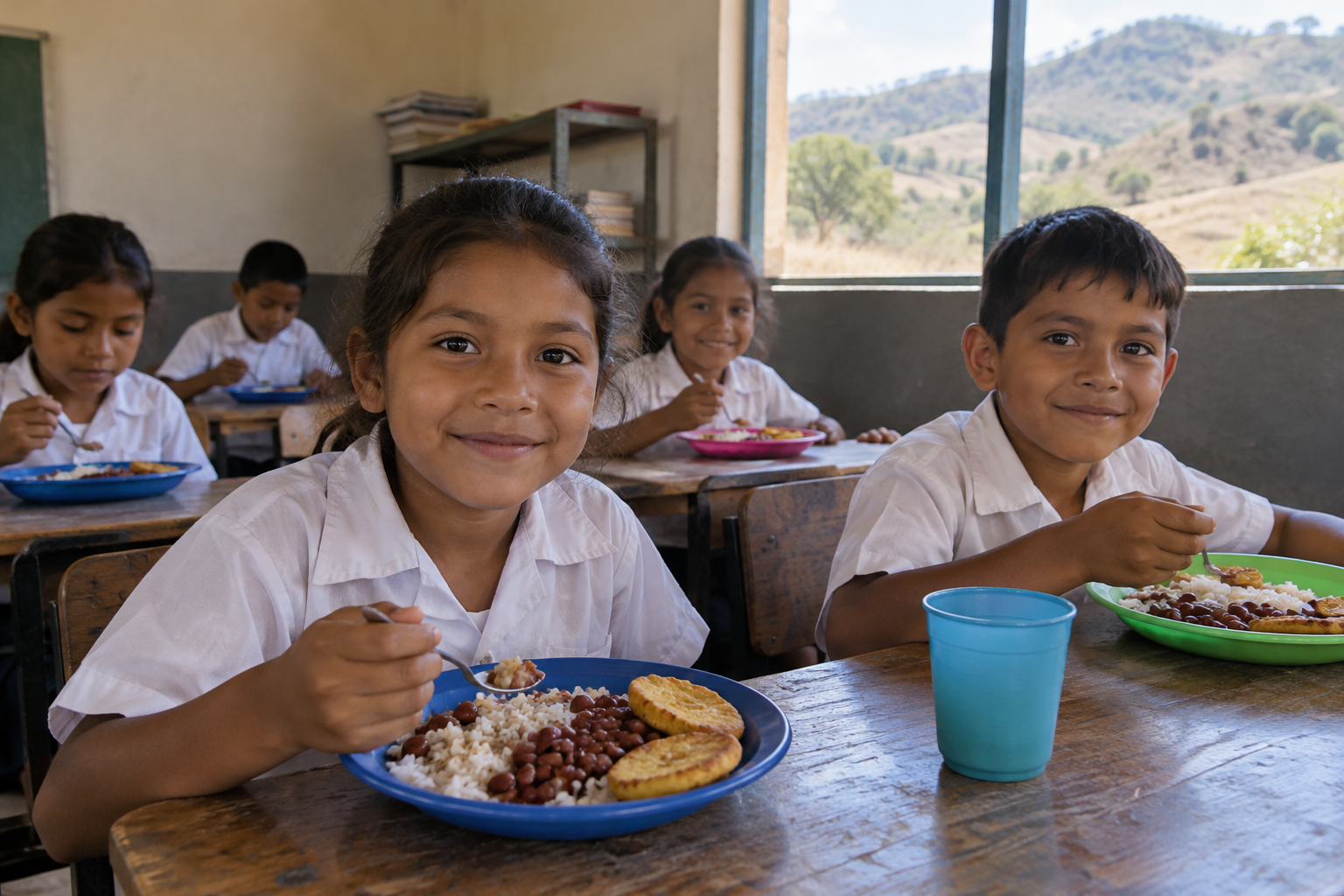
The country runs a National School Feeding Program with WFP’s support, and the scale of it is remarkable for a nation this size. In the first delivery round of 2026 alone, WFP moved more than 5,900 metric tons of food into schools, and over 1.2 million schoolchildren received daily meals — in many places a hot plate of rice, beans, and the little corn fritters Hondurans call catrachitas, increasingly supplemented with fresh produce. A private Honduran bank foundation underwrote 60-day rations for another 6,600 children across 143 schools in March.
Why does this matter so much? Because a school meal does three jobs at once. It feeds a child who may not have eaten breakfast. It gives a parent a reason to send that child to school instead of to the fields, which is why the program is explicitly tied to reducing dropout. And it buys the household a little slack during the hungry months — one meal a day that does not have to come out of the sack in the corner. I have argued before that education is the surest path out of poverty for a Honduran child; a school lunch is the thing that keeps the child in the chair long enough for the education to happen.
The program is not perfect. Deliveries arrive in rounds, and the gap between rounds can land right on top of the lean season. Rural schools in the Dry Corridor sometimes lack a kitchen, a stove, or a reliable water source to cook with — which is one reason I keep coming back to clean water and sanitation as a prerequisite for almost everything else. And a school meal reaches children aged six and up. The first 1,000 days are over long before a child walks into a classroom.
Reaching the Children Who Are Not in School Yet
That is the hard part, and it is where the Foundation has tried to concentrate its thinking. The children most at risk of stunting are the ones you cannot reach through a school: the pregnant mother, the newborn, the toddler being raised by a grandmother because both parents are working in another country.
I wrote last month about how multigenerational households and the compadrazgo system hold Honduran families together, and about the growing number of grandparents raising grandchildren alone. Those grandmothers are, in practice, the front line of early-childhood nutrition in the Dry Corridor. They are also, very often, undernourished themselves, and working with knowledge handed down from a time when a baby was weaned onto sweetened coffee and tortilla broth at three months.
So the interventions that work at this stage are not food trucks. They are smaller and more human: training community health workers to promote exclusive breastfeeding for the first six months; getting iron and micronutrient supplements to pregnant women; teaching caregivers which locally available foods — eggs, beans, squash, the dark greens that grow wild on the hillside — can fill the gaps; home gardens with a little drip irrigation that survive the canícula; and village-level growth monitoring so that a child who is falling behind is noticed in month four, not year four. WFP’s April brief mentions training health-center staff in two departments on exactly this kind of breastfeeding promotion. It is not glamorous work. It is the work.
Why an Accountant Cares About Stunting
I run 1-800Accountant, and I think about compounding for a living. Stunting is compound interest running in reverse. A child who loses cognitive capacity in the first two years earns less at thirty, pays less in taxes at forty, and is more likely to need public health services at fifty. Multiply that by 220,000 children and you have a drag on an entire national economy that is invisible on any single year’s balance sheet and enormous over a generation.
The flip side is just as true, and it is the reason I find this issue so motivating rather than simply sad. Early nutrition has one of the highest returns of any investment a society can make. The food is cheap. The supplements are cheap. The health-worker training is cheap. What is expensive is doing nothing and paying for it over the next sixty years. When I look at the WFP brief and see that a nutrition program for the most vulnerable mothers and children is short by a few million dollars, my accountant’s brain does not see a charity line item. It sees the single most underpriced asset in the country.
That is also why Sandra and I have never been interested in a relief model alone. Emergency food during a drought is necessary, and we support it. But the goal of the Savage-Rivera Foundation is to get a family to a place where the hungry months are shorter every year — a more resilient crop, a small reserve, a mother who knows what to feed her baby and has a clinic she can reach. Rural poverty in Honduras is different from urban poverty precisely because it is so tightly bound to the land and the rain; the solutions have to be, too.
What You Can Do This Month
If you are reading this in November, you are probably about to sit down at a full table of your own. I am not going to tell you to feel guilty about it. I am going to ask you to do one or two concrete things.
- Give to school feeding or early-nutrition work in Honduras. WFP’s Honduras operation, and the Honduran and international organizations that partner with it in the Dry Corridor, convert small gifts into meals at a rate that would embarrass most of what I see in the private sector.
- Give monthly, not once. The hungry months come every year. A standing gift lets a program plan for the lean season instead of scrambling through it.
- Learn the vocabulary. Stunting. The first 1,000 days. The Dry Corridor. The canícula. Knowing the words makes you a better advocate and a better donor.
- Follow along. Sandra and I share what we are seeing in Honduras, along with the occasional koi or LEGO interruption, on the Mike Savage New Canaan Facebook page. It is the easiest place to keep up with the Foundation’s work between these posts.
And if you are a business owner or an entrepreneur, consider this an invitation to think about your giving the way you think about your capital allocation. The highest-return, lowest-risk investment I know of is a hot meal for a six-year-old in Choluteca and a bag of fortified food for her baby brother. I would put that up against any ten-year bond.
A Note From the Rest of My Life
Regular readers know that this Foundation is one of several things that occupy me, and that I think the hobbies and the mission belong in the same conversation. In November my koi are slowing down for winter — I have written on savagenewcanaan.com about how feeding a pond has to change with the water temperature, and I find the parallel with the Dry Corridor’s seasons hard to ignore: you feed according to the season, or you lose fish. Over at mikesavagenewcanaancollections.com I have been thinking about stewardship — what it means to preserve something fragile for the long term — which is not so different from what a mother in Lempira is doing with a toddler. My travel notes are where I write about Honduras as a place to love rather than a problem to solve. And the muscle cars on mikesavagenewcanaan.com are, if I am honest, where I go when I need to stop thinking about any of this for an afternoon.
Thank you for reading, and for caring about a corner of the world that rarely makes the news. Happy Thanksgiving from New Canaan.
About the author: Mike Savage of New Canaan, CEO of 1-800Accountant, founder of Savage-Rivera Foundation. Mike and his wife Sandra established the Foundation to address family poverty in Honduras and Central America. He also writes about koi ponds and LEGO at savagenewcanaan.com, muscle cars at mikesavagenewcanaan.com, sneakers and contemporary art at mikesavagenewcanaancollections.com, and travel at michaelsavagenewcanaan.com.