By Michael Savage
Every September, Honduras turns blue and white. Flags go up over doorways in Tegucigalpa, school bands practice their drum lines in dusty village squares, and the whole country counts down to the fifteenth — Independence Day, the anniversary of the moment in 1821 when Central America stepped out from under Spanish rule. It is a month of national pride, of patriotic parades and family gatherings and the word “catracho” spoken with real feeling.
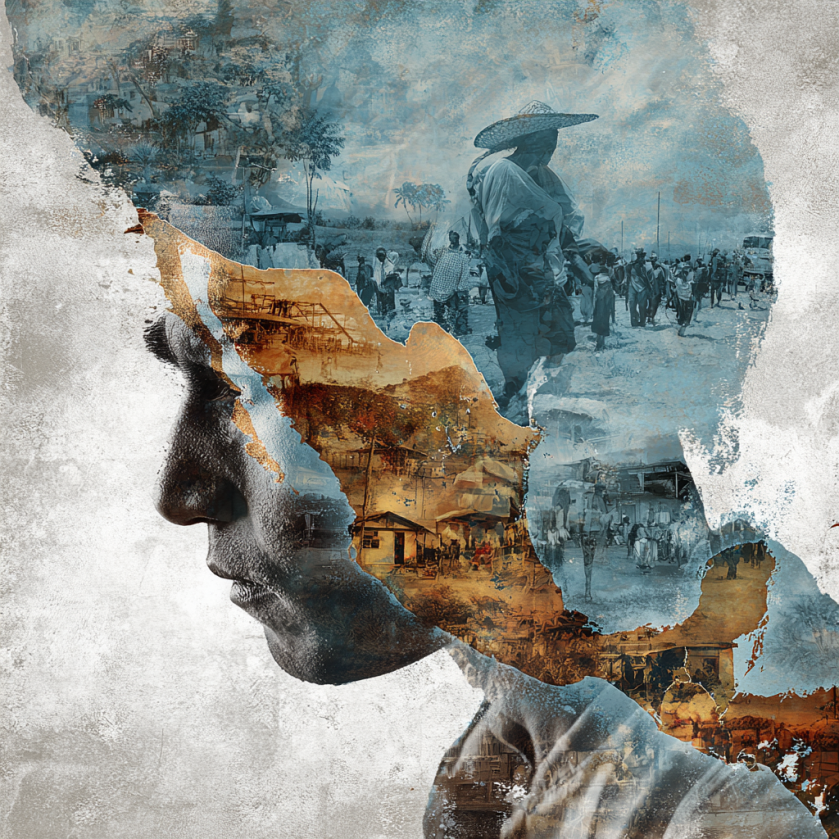
It is also, quietly, the month when the mountains hold their breath. Because in a few short weeks, in the highlands of Copán and Lempira and Intibucá and La Paz, the coffee cherries will begin to blush red, and something close to a million Hondurans will pick up a basket. If you want to understand how Honduran families actually live — how they earn, how they migrate, how they celebrate, how they endure — the coffee harvest is a better teacher than almost any statistic.
At the Savage-Rivera Foundation, our work in Honduras has always been rooted in the conviction that you cannot help a community you do not know. Over years of visits, conversations, and partnerships, one theme returns again and again: coffee is not just an export line item in Honduras. It is a calendar, a culture, and for hundreds of thousands of families, a livelihood held together by a set of skills passed down through generations.
A Crop That Arrived Quietly and Stayed
Coffee reached Honduras in the eighteenth century, but for most of its history here it was a modest thing — a shade crop grown on steep mountain plots by farmers who mainly grew food. Bananas, not coffee, were the story of Honduran agriculture for generations, and the country was known abroad for fruit rather than for anything you would put in a cup.
That changed in the second half of the twentieth century. Rising global demand and government support pushed production upward through the 1960s, and in the 1970s the government established IHCAFE, the Honduran Coffee Institute, to provide technical training and credit to growers. Between 1970 and 1996, national production grew by more than 200 percent, and coffee overtook bananas as the leading export. A crop that had lived in the margins became the backbone of the rural economy.
The ascent was not smooth. Hurricane Mitch tore through in 1998 and destroyed an estimated 80 percent of the crop. The international price collapse of 1999 followed almost immediately, wiping out margins for smallholders who had no cushion, and driving one of the significant waves of migration out of the Honduran countryside. Anyone who wonders why coffee prices matter so much to Honduran families should look at that two-year window: a storm and a market shock, back to back, and the consequences still visible in half-empty villages a generation later.
And yet the sector came back, larger than before. Honduras is today the largest coffee producer in Central America and among the top producers in the world. According to the U.S. Department of Agriculture’s Foreign Agricultural Service, Honduran production is forecast at roughly 6.03 million 60-kilogram bags for the 2026/27 marketing year, harvested from around 330,000 hectares and more than two billion bearing trees. Exports in the year to April 2026 reached about 3.17 million bags, worth roughly $1.39 billion — a 33 percent increase in value over the prior year. You can read the full USDA Foreign Agricultural Service coffee report on Honduras for the complete production and trade picture.
Six Regions, One Mountain Country
Honduras recognizes six official coffee-growing regions, and each has a personality. Copán, in the west, near the great Maya ruins, gives chocolate-heavy, rounded cups. Montecillos, spanning La Paz and parts of Comayagua and Santa Bárbara, is known for bright citrus and stone fruit. Opalaca, along the Intibucá highlands, tends toward delicacy and floral notes. Comayagua sits in the central mountains, El Paraíso runs along the Nicaraguan border, and Agalta occupies the rugged east.
The geography does the work. Most Honduran coffee grows between 1,100 and 1,700 meters above sea level, on slopes steep enough that harvesting is still done entirely by hand — there is no mechanization possible on a hillside like that. Cool mountain air slows the ripening of the cherry, which gives sugars and acids more time to develop. The result is a cup with sweetness and clarity that specialty buyers now compete for.
Marcala, in the Montecillos range of La Paz, made history in 2005 when it became the first coffee-growing area in all of Central America to receive a protected denomination of origin. That designation mattered far beyond marketing. It was formal, legal recognition that Honduran coffee had terroir — that a bean from these particular slopes, at around 1,550 meters, in these particular soils, was distinctive and worth paying more for. It began the long shift in the country’s reputation from bulk commodity supplier to origin worth naming.
Marcala is also Lenca country. The Lenca are Honduras’s largest Indigenous group, and much of the highland coffee land in La Paz and Intibucá sits within Lenca communities whose relationship to these mountains predates the crop by centuries. The intersection of Indigenous land, water rights, and agricultural development in western Honduras is a story we have explored before in our piece on Honduras’ Indigenous communities and rights, and coffee sits squarely in the middle of it.
La Corta: How the Harvest Shapes the Family Year
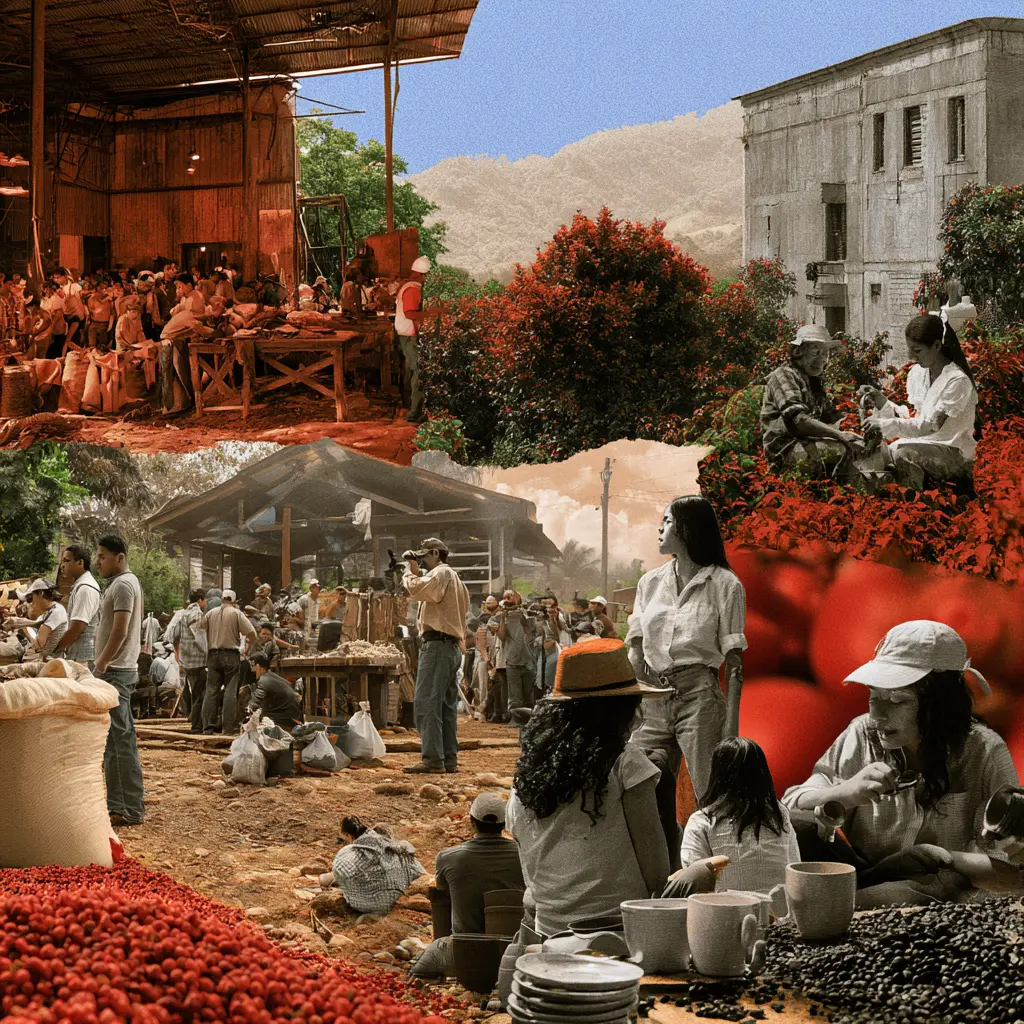
From roughly October through April, Honduras enters la corta — the cut, the harvest. It is the single largest seasonal mobilization of labor in the country.
Whole families move for it. Parents, grandparents, and often children travel from lowland towns to highland fincas, sometimes staying for weeks in temporary housing on the farm. Pickers cross in from Guatemala and Nicaragua to work the border departments. The International Labour Organization’s mapping of the Honduran coffee value chain estimates that the sector generates more than 1.1 million jobs — permanent, temporary, direct and indirect — and supports roughly 120,000 producing families along with as many as 350,000 permanent workers. You can review the ILO’s value chain mapping of Honduran coffee for the detailed breakdown.
Picking is skilled work, whatever outsiders assume. A good picker takes only the ripe cherries and leaves the green ones on the branch for the next pass, which means the same tree is visited three or four times across a season. Pay is by volume — traditionally by the lata, a can measure — so a fast, accurate picker earns meaningfully more than a slow one. Children learn the difference between a ripe and an underripe cherry the way children elsewhere learn to ride a bike.
That last fact carries real weight. Harvest season overlaps with the school year, and in households where every basket counts, the pull to keep a twelve-year-old in the rows instead of the classroom is powerful and understandable. It is one of the reasons we have written repeatedly about the tension between immediate family income and long-term opportunity, including in our examination of the link between family poverty and child labor in Honduras. Coffee is not the villain in that story — it is often the only cash the household will see all year — but any honest account of the harvest has to name the trade-off it puts in front of parents.
Coffee as a Household Economy
The structure of Honduran coffee is what makes it socially significant. This is not a plantation industry. Estimates put the number of producers at around 120,000, and depending on the survey, somewhere between 80 and 92 percent of them are smallholders farming less than 3.5 hectares. Roughly 17 percent are mid-sized, and only about 3 percent qualify as large. Coffee accounts for something on the order of 5 percent of national GDP and generates more employment and more foreign exchange than any other single economic activity in the country.
Translate that into a household. A family with two hectares in Lempira might produce enough for a single year’s income delivered in one lump, in February or March, after a season of expenses paid on credit. That money has to cover school fees, medical costs, seed for the next cycle, and the household’s ordinary needs for the following twelve months. There is no second paycheck. When the price is good, the roof gets fixed and a child goes to secondary school in town. When the price falls or the rust hits, the calculation changes overnight — and so does the pressure to migrate.
This is exactly the dynamic we described in our look at the impact of rural versus urban poverty in Honduras. Rural poverty in Honduras is not usually about the absence of work. It is about the volatility of income and the absence of buffers.
Cooperatives are the most important buffer smallholders have built. Organizations like COMSA in Marcala pool volume so members can negotiate as a bloc, share the cost of processing and certification, and access credit that no individual grower could obtain alone. Cooperative membership is often the difference between selling wet parchment at the farm gate for whatever the coyote offers and selling a traceable, certified lot to a specialty importer at several times the price. As someone who has spent a career in small business finance, I find this the most instructive part of the whole system — a lesson I wrote about at length in what my accounting career taught me about ending poverty with small loans. Access to capital at the right moment is frequently the whole ballgame.
From Commodity to Character
The most encouraging development of the past two decades is that Honduras stopped competing on price alone.
In 2004, IHCAFE partnered with the Alliance for Coffee Excellence to bring the Cup of Excellence competition to Honduras — a blind cupping tournament in which any farmer, however small, can submit a lot and be judged purely on what is in the cup. The 2026 Honduran competition named 30 winning coffees scoring 87 points or higher, with top lots from Intibucá and Santa Bárbara breaking 90. One Geisha lot sold at auction for $90 per pound, a figure that would have been unimaginable to a Honduran grower in 1999.
Just as telling is the rise of Parainema, a disease-resistant variety developed in Honduras that has proven it can deliver both durability and cup quality. The 2026 competition gave it its own category. For a country long treated as a source of blending stock, a homegrown variety winning on flavor is a matter of genuine national pride — the agricultural equivalent of a hometown team going to the final.
The Women Behind the Cup
Women have always done a disproportionate share of the harvesting and farm maintenance in Honduran coffee, and historically they controlled very little of the money. That is changing. Women increasingly manage farms outright, hold leadership positions in cooperatives, and market their own lots. Producer groups organized by and for women — some marketing under names like Manos de Mujer, “women’s hands” — now sell directly to international buyers.
It is one of the clearest examples of a pattern we see across our work: when income runs through a woman’s hands in a Honduran household, a larger share of it reaches the children’s schooling and health. Coffee has become an unexpectedly effective vehicle for that shift, because certification and traceability create a paper trail that names the producer — and increasingly, that producer is a woman.
What Threatens the Harvest
Two pressures dominate every conversation with growers.
The first is coffee leaf rust, la roya, the fungus that devastated Central America in 2012 and 2013 and has never fully gone away. Incidence was measured at 8.44 percent nationally in March 2026, up from 7.57 percent the prior year — manageable, but a reminder that the threat is permanent and that a warm, wet year can turn a modest infection into a wipeout.
The second is the weather itself. Rust thrives in warmth and humidity, and the altitude band where quality arabica grows is creeping upward as temperatures rise. Hurricanes remain an existential risk for a mountain crop on erodible slopes; Eta and Iota in 2020 were a reminder of how quickly a season can vanish. We examined this in detail in our article on Honduras and the climate crisis, and coffee is where the abstraction of climate change becomes a very specific line in a family ledger.
Coffee at the Kitchen Table
For all the economics, the most Honduran thing about coffee is how it is drunk.
In the countryside it is still often made in a colador, a cloth sock filter suspended over a pot, and it arrives sweet — sugar added during brewing rather than after. It is served at dawn before work, again mid-morning, and again when a visitor appears at the door, because offering coffee is simply what you do when someone arrives. It accompanies pan de coco on the Caribbean coast and baleadas in the morning across the country, a pairing we celebrated in our tour of the gastronomic wonderland of Honduras.
There is a particular irony worth naming. For decades, the best Honduran coffee left the country and the domestic market drank the rejects. That is shifting too. Cafes in Tegucigalpa, San Pedro Sula, and Copán Ruinas now serve single-origin Honduran coffee to Honduran customers, and a generation of young baristas is treating the national crop as something to be proud of at home, not just something to ship. Travelers who want to see this for themselves will find highland coffee country among the most rewarding parts of the region, and I have written more about exploring Central America on my travel blog.
Why This Matters to Our Work
The Savage-Rivera Foundation was founded to support families in Honduras, and understanding coffee has changed how we think about that mission.
It taught us that the relevant unit is the year, not the month. A family whose entire income arrives in one payment in March needs different support than one with a weekly wage — savings tools, credit at planting rather than charity at harvest, and school support timed to the months when cash is thinnest. It taught us that organization beats aid: a functioning cooperative delivers more durable gains to a village than any single donation. And it taught us that quality is a poverty strategy. Every point of cupping score, every certification, every named lot is money that stays in the highlands instead of accruing to someone downstream.
So when the flags come down after September 15 and the first cherries redden on the slopes above Marcala, know that what follows is not merely an agricultural season. It is the Honduran family economy, running at full tilt, for six months, by hand, on some of the steepest ground in the Americas. It deserves more attention than it gets — and better prices than it usually receives.
About the Author
Mike Savage of New Canaan, CEO of 1-800Accountant, founder of Savage-Rivera Foundation, established the foundation with his wife Sandra to support families facing poverty in Honduras. Outside his professional and philanthropic work, he writes about his hobbies and collecting interests at Savage New Canaan and Mike Savage New Canaan Collections. To follow the foundation’s work and his other projects, visit Mike Savage of New Canaan on about.me.